NY1 Omits Bronx in CD 13 Report

23 Jun

First it was the New York Times that incorrectly described the 13th Congressional District as including the south Bronx, when it’s the northwest Bronx that’s part of the newly configured CD. But now NY1 has gone a step further in misinforming voters by excluding the Bronx altogether. “Upper Manhattan Democrats will head to the polls on Tuesday to choose the nominee,” anchor Lewis Dodley told viewers. (Thanks to the Bronx Matters reader who alerted us to this.)

It’s NY1’s turn to make a correction, and preferably do a story that takes a look at the Bronx portion of the district.

Super PAC Mailers Supporting Espaillat Riddled with Errors

21 Jun

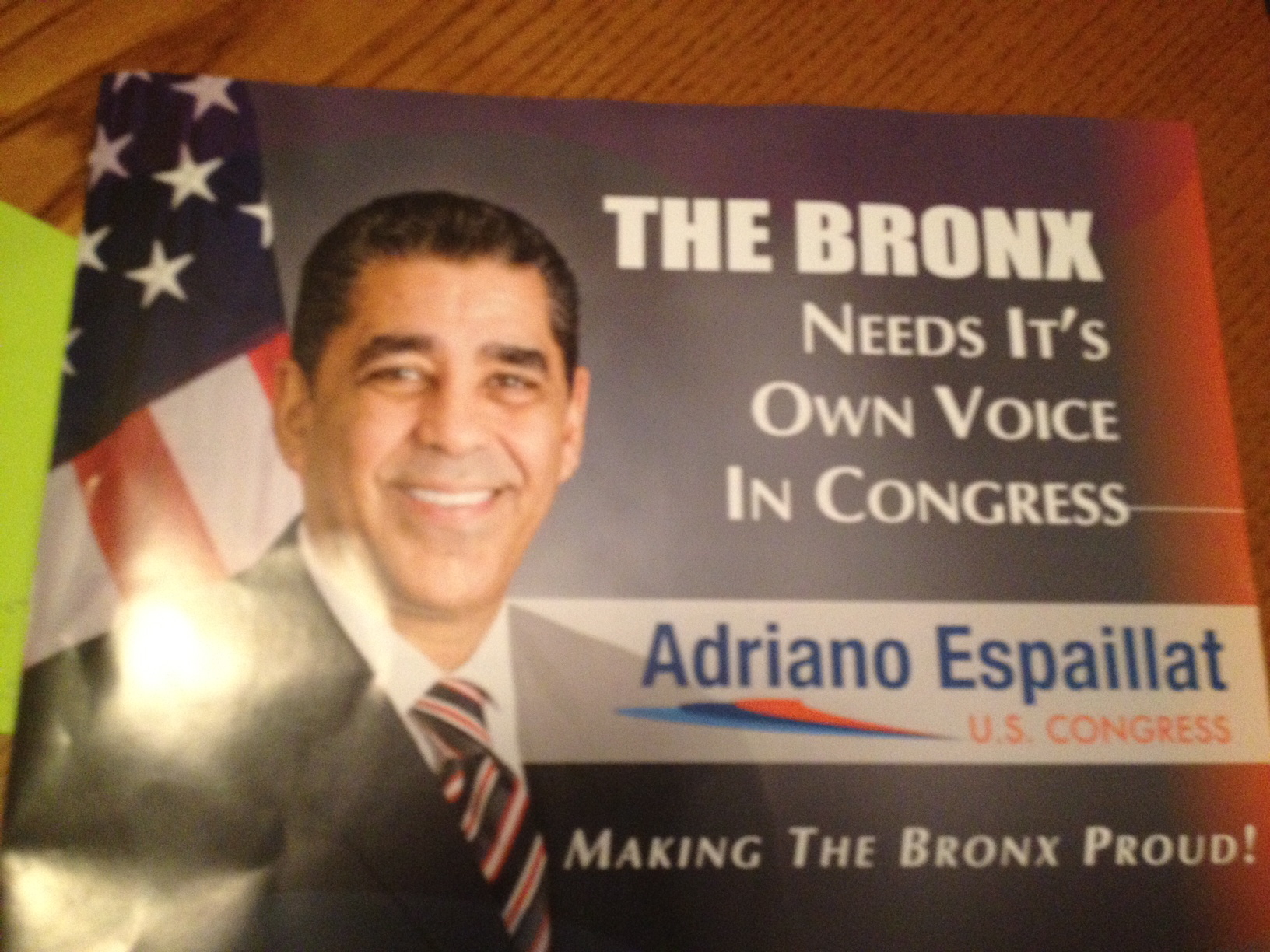
The mailings many of us Bronxites living in the new 13th Congressional District received yesterday would appear to most voters that they were from Adriano Espaillat (and that’s the way they appeared to me initially). But when you look at the fine print you see that they’re the work of the Latino Empowerment PAC, a Super PAC that by law should have no connection with Espaillat, a state senator seeking to unseat Congressman Charles Rangel in a newly drawn district that includes a large chunk of the northwest Bronx.  There’s no evidence that there is a connection with Espaillat, and the closer you look at them the more disappointed the candidate is likely to be that they were sent out with his name and face on them.

As for the errors, let’s begin with the smallest and work our way up.

I asked my 8-year-old daughter what was wrong with the mailer pictured below, and she explained it by simply reading it out loud, “The Bronx Needs It Is Own Voice in Congress.”  (She chose to bring the fliers to school to share the errors with her class this morning.)

OK, getting past the grammatical error, the content implies that the Bronx does not have a voice in Congress. Congressmen Jose Serrano and Eliot Engel will probably be rather irritated to read this.

Which brings us to the totally mistaken claim (below) that Senator Espaillat is “from the Bronx.” He is from Manhattan as are all five candidates running. And while he has been supported by Bronx leaders such as former borough president Fernando Ferrer, who is pictured on the flier, as well as State Senator Gustavo Rivera and Councilman Oliver Koppell— the most prominent photo here is of Manhattan Democrat Mark Levine.

Oh, speaking of that apostrophe … We now see where they stole it from …

The above mailer with the missing apostrophe and attacking incumbent Rangel is also the work of the Latino Empowerment PAC. They’re listed on web sites tracking campaign financing with Jeffrey Garcia as the Treasurer. A Huffington Post report on recent Super PAC registrations indicates that Garcia and the PAC are from Coral Gables, Florida. We’ll let you know if we learn anything else about this. (And let us know if you do.) And don’t forget that the primary election is next Tuesday, June 26.

Update: According to this Federal Election Commission filing, the chairman of the Latino Empowerment PAC is Fransisco Cerezo (the unusual spelling of the first name — with an “s” rather than a “c” — is how it’s written on the form). Thanks to journalist David Lewis for leading me to this.

—Jordan Moss

Times and Post Miseducate Readers on 13th Congressional District Primary

18 Jun

[Update 6/19/12 The New York Times did the right thing this morning, making the correction on the print edition editorial page and on the Times’ website. The Post hasn’t yet. Also, we’ve made a correction below ourselves. Riverdale residents who were in the 17th District, represented by Eliot Engel, will still be represented Engel or whoever challenges him in November. But it is now the 16th District, rather than the 17th.]

A week from tomorrow — on Tuesday, June 26 — the voters that know about it and act on that knowledge will participate in an oddly scheduled Congressional primary. Usually, such primaries take place in September at the same time as primaries for the Assembly and State Senate. But due to the complicated and distressing politics around redistricting, this primary will have its own day.

Here in the Bronx, the primary is highly significant because most residents of the northwest Bronx will no longer be in the Congressional District now represented by Eliot Engel (will change from the 17th to the 16th District). Almost all northwest Bronx residents, except those living in Riverdale (still represented by Engel in the 16th), will be in the 13th District.

Daily newspapers have an opportunity — and more importantly, a responsibility — to help educate their Bronx readers about an epic change in who will represent them in Congress.

But yesterday, in endorsing Clyde Williams, a former official in the Clinton administration, The New York Times inexplicably listed the south Bronx as the section of the borough in the new district (even while they took pains to list several of the individual Manhattan neighborhoods in C.D. 13).

There is not a block in the newly drawn 13th Congressional district that is in the south Bronx, even if you define the south Bronx widely as every neighborhood below the Cross Bronx Expressway. The Times’ editorial writers failed to simply look at the maps on-line, or simply check in with their political reporters.

With only eight days to the primary, the Times has a duty to set the record straight. Not just a correction on page 2 that almost nobody reads, but on the editorial page.

The New York Post added to the miseducation in their endorsement of Espaillat, with a headline indicating the new district as the 15th. They need to do the right thing, too.

Meanwhile, here are some links to coverage on the race. First off, click here for last week’s debate on BronxTalk, which included all the candidates except for Charles Rangel.

Here’s a primary news roundup, prepared by Norwood News editor Alex Kratz, with a bunch of links to recent coverage of the race. And here’s a link to more Norwood News coverage of this primary and the candidates vying for the seat.

The Riverdale Press also has a run a bunch of articles on this critical primary race. Check them out here.

Here are links to the websites of candidates Adriano Espaillat, Joyce Joynson, Charles Rangel, Craig Schley, and Clyde Williams.

And finally, here’s a map of the 13th Congressional District. (To see the maps of other districts in the city and state click here.)

A Harlem River for the Bronx?

15 Jun

Friends of Brook Park members canoe in the Bronx Kill. Photo by Dirk Ewers.

The Harlem River, which borders the Bronx’s south and west sides, is not really a recreational resource for Bronxites. But just like in the borough on the other side of the river (Manhattan) it can be. There are major difficulties — the presence of industry and factories, and a 99-year-old lease granted long ago for a chunk of waterfront land, and the lack of city elites’ obsession with Bronx waterfront space, unlike similar efforts in Manhattan (see Highline) — but they are not insurmountable.

Haven on the Harlem, a special project of the Mott Haven Herald and the NYCity NewsService, both of which are published by the CUNY Graduate School of Journalism, digs deep and wide all along the river, interviewing officials, activists, residents and landlords, coming up with  articles (as well as on-line videos and interactive maps) detailing the state and potential fate of the waterfront and the river itself.

This project was led by by Bronxite David Lewis, the veteran journalist and CUNY professor, and produced by his students.

Haven on the Harlem, and all the other work associated with the the NewsService and the Herald, as well as its sister publication the Hunts Point Express, are really models for the kind of public service that academic journalism projects can provide.

John Liu on BronxTalk Tonight

4 Jun

Update: Here’s the link for the video of the Liu interview: http://www.bronxnet.org/tv/bronxtalk/viewvideo/1634/bronxtalk/bronxtalk–june-4-2012

Comptroller John Liu will be on Gary Axelbank’s BronxTalk tonight at 9 p.m. According to Axelbank: “He’ll talk about the Fresh Direct deal, the filtration plant, politics, and much more. BronxTalk is Monday nights at 9:00pm on Bronxnet’s channel 67 (Fios 33).”

A Bronx Foster Care Survivor’s Tough Journey to Independence

3 Jun

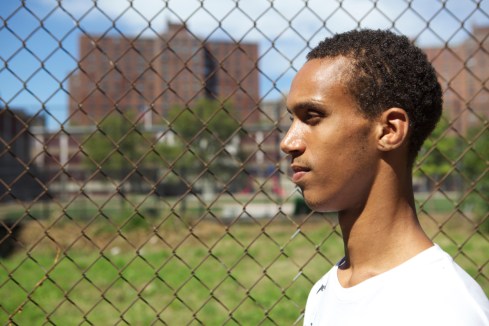
Fekri Kram, a Tunisian immigrant in the Bronx, has faced a number of challenges since he aged out of foster care. (Photo by Bruce Byers )

Ed. note: The following article, by former Riverdale Press reporter Tommy Hallissey, about Bronxite Fekri Kram, is part of a joint project of SalaamGarageNYC and the Long Island Children’s Museum, highlighting problems faced by those aging out of foster care. Entitled “Everybody Needs Someone, The Aging-Out of Foster Care Project,” the project is currently fundraising with crowdfunding site Kickstarter.com (through June 13, 2012).  The exhibition runs June 16-September 2, 2012 at the LICM located at 11 Davis Ave. in Garden City, NY. Opening event June 23, 2012 1-4:30pm.

By Tommy Hallissey

Without a word, Fekri Kram’s disarming, toothy smile betrays the suffering he endured coming of age in the New York City foster care system.  His crooked pearly whites also hide the agony of being sold into slavery in Tunisia at the age of 5 for a mere $100.

Taken from Tunisia, Fekri was exchanged between parental figures that were often physically and sexually abusive. At age 9, he was beaten severely in Jackson Heights, Queens by his family of the moment. After he was hospitalized, the city recommended he not return to an abusive environment.

Without doting parents, Fekri spent most of his formative years in the less than picturesque settings of New York foster homes. At 21, Fekri was one of nearly 1,000 individuals that year forced to navigate independent living after “aging out” of the city’s foster system. These young adults must transition from a system of familiar structure to the unsettled, often cold reality of independence. According to a 2011 report by the Center for an Urban Future, roughly two-thirds of the 16,000 foster youth in America age out of the system without reuniting with their birth families or being adopted.

“I’ve been through hell and back,” explained Fekri, wearing faded, ripped jeans and a trendy white t-shirt. His inner strength has fueled his drive to succeed where others would have quit. He has overcome such obstacles as slavery, poverty, abuse and solitude to now enjoy some of the gifts of independence, including no direct supervision or curfew.

Continue reading

NYCHA’s Information Lockdown, and Giving Credit Where It’s Due

25 May

First things first … The Daily News reported the other day on the New York City Housing Authority’s $10 million contract with the private firm Boston Consulting Group, which NYCHA is keeping under lock and key, and the fact that the agency’s chief used to work for BCG. It’s an important story and great it’s getting more ink, but the paper failed to acknowledge that City Limits broke all aspects of this story back in their November issue along with their excellent wide-ranging investigation into the tremendous spike in private consultants retained by the Bloomberg administration. It’s called: “Beyond City Time: When private firms take on public work, there’s more than money at risk.”

Failure of the dailies and other big news outlets to credit smaller ones that broke stories first is chronic. In my 17 years as Norwood News editor, it was a never-ending (and unsuccessful) battle to get big papers and broadcast outlets like Bronx News 12 to credit us for stories they picked up from us. Instead they regularly used Bronx community papers as a wire service but without credit or compensation. It was nice to see Arthur Brisbane, The New York Times’ public editor, address this in his column last Sunday. He made an excellent case for how unfair it was for The Times to run their investigation of lax prosecution of sexual abuse in Brooklyn’s Orthodox community without crediting the smaller weeklies like Jewish Week and the Jewish Daily Forward who did dogged, ongoing reporting of the issue long before the Times got to it.  We need to keep up the drumbeat. Like the stonewalling public agencies that all good journalists try to hold accountable, the bigger outlets won’t change their arrogant ways until we all direct some of that sunlight on them.

OK, that said, back to the critical issue at hand: NYCHA forked over $10M of NYC taxpayer cash to BCG to examine the agency’s growing problems but they won’t let the public see it. This is not some abstract wonkish policy endeavor. NYCHA is way behind on repairs of apartments in desperate conditions where residents’ health and well-being are at stake. If there’s any information in that report indicating how that can be reversed, and even if there isn’t, the public has the right to know. We all paid for it after all.

Yesterday, The Daily News (yes, we’ll credit them despite the above lamentations, because it’s the right thing to do) reported on Bronx residents of NYCHA buildings threatening to sue the Bloomberg administration for the backlog in repairs. The Bronx Documentary Center in Melrose also had a stirring, moving photo exhibit a couple of months ago illustrating how conditions at nearby NYCHA buildings are undermining the health of residents young and old in the local projects.

Bottom line: The lockdown of public information (which is something of a theme in Bronx Matters this week) harms the public. We should all do what we can to set it free.

NYPD Still Hiding Neighborhood Crime Data

23 May

The previous post on that New York World stop-and-frisk map got me thinking once again about how critical it is for the NYPD to release crime data for neighborhoods rather than just precincts, which is what the weekly CompStat reports cover. Precincts have populations as large as many cities (for example there are about 150,000 people in the 52nd Precinct). The NYPD understands very well that precinct stats alone are not that not helpful in determining where particular categories of crime listed in the CompStat reports are the most prevalent. That’s why they generate more targeted data, called sector stats, for at least a dozen areas within every precinct in the city.

The NYPD rarely makes this data available. At the Norwood News, where I was editor until last September, we once got it from the 52nd Precinct commander, but NYPD brass prevented him and future commanders from sharing it again. So the last time we got it we waited more than a year for the agency to fulfill our Freedom of Information Law request and they complied only after an NBC-TV report (video) highlighted our editorial campaign to get them to release the data.

The data is critical simply because people have the right to know whether they are safe in their own neighborhoods. Precinct-wide data is not helpful in that regard. Crime may be down precinct-wide but it could be up significantly in a sector (which may be one reason the NYPD is locking down the info). New Yorkers should be able to easily find out where crime is going down and where it’s going up.

And they should have easy access to data that indicates what crimes are on the upswing. Lots of car thefts in the area? A spike in rapes? An uptick in assaults? Knowing this info would help residents ensure their own safety and also be on the lookout for crimes in progress. How can more eyes and ears on the streets not be useful to the NYPD?

Last year, motivated by the Norwood News’ reporting, Council Member Fernando Cabrera introduced legislation that would require the NYPD to release the sector stat data on a regular basis. It’s still in committee and we have a call into Cabrera’s office to find out more about its status. We’ll let you know where it’s at soon. In the meantime, take a look at the bill:

It’s not complicated. The NYPD collects this data on the taxpayer dime, yet keeps it hidden from public view. The legislation above would fix that. We hope to see action on it soon.

—Jordan Moss